2024 AGU POD Listening Sessions
December 11 & 12, 2025; AGU ’24 Poster Hall – Pod 3 (Washington Convention Center)
– Amanda Borth, Mara Karageozian, Emily Hostetler (Co-organizers)
Carbon Dioxide Removal: Beyond Technical Challenges
Just 5 years ago, carbon dioxide removal (CDR) was a particularly niche set of emerging solutions to climate change studied by a handful of physical scientists, social scientists, and policy wonks. But, the multiple packed scientific sessions, rows of posters, informal conversations, and hallway ‘hellos’ related to CDR at AGU24 show how the tide is drastically changing. CDR is now one of the hottest topics in climate change solutions research, and CSPO was right in the mix – but in the space between science and society.
As climate change continues to escalate, an unprecedented wave of collaboration is emerging across disciplines and sectors. Mediating climate change necessitates supporting solutions from all sides of the problem, incorporating carbon emission reductions and removal. One technical solution for carbon reduction is carbon dioxide removal (CDR), a promising yet complex set of climate change solutions gaining attention from the global scientific community. Scientists worldwide are developing CDR strategies to reduce climate impacts on society. In recent years, CDR has emerged as a crucial tool for reaching the United States’ goal of net-zero greenhouse gas emissions by 2050. While CDR’s technical hurdles are significant, its social implications pose potentially greater challenges. Success requires more than installing new technology—it demands understanding how these systems affect local communities and families. CDR’s future depends as much on social license as on technical efficiency.
Building Bridges at AGU
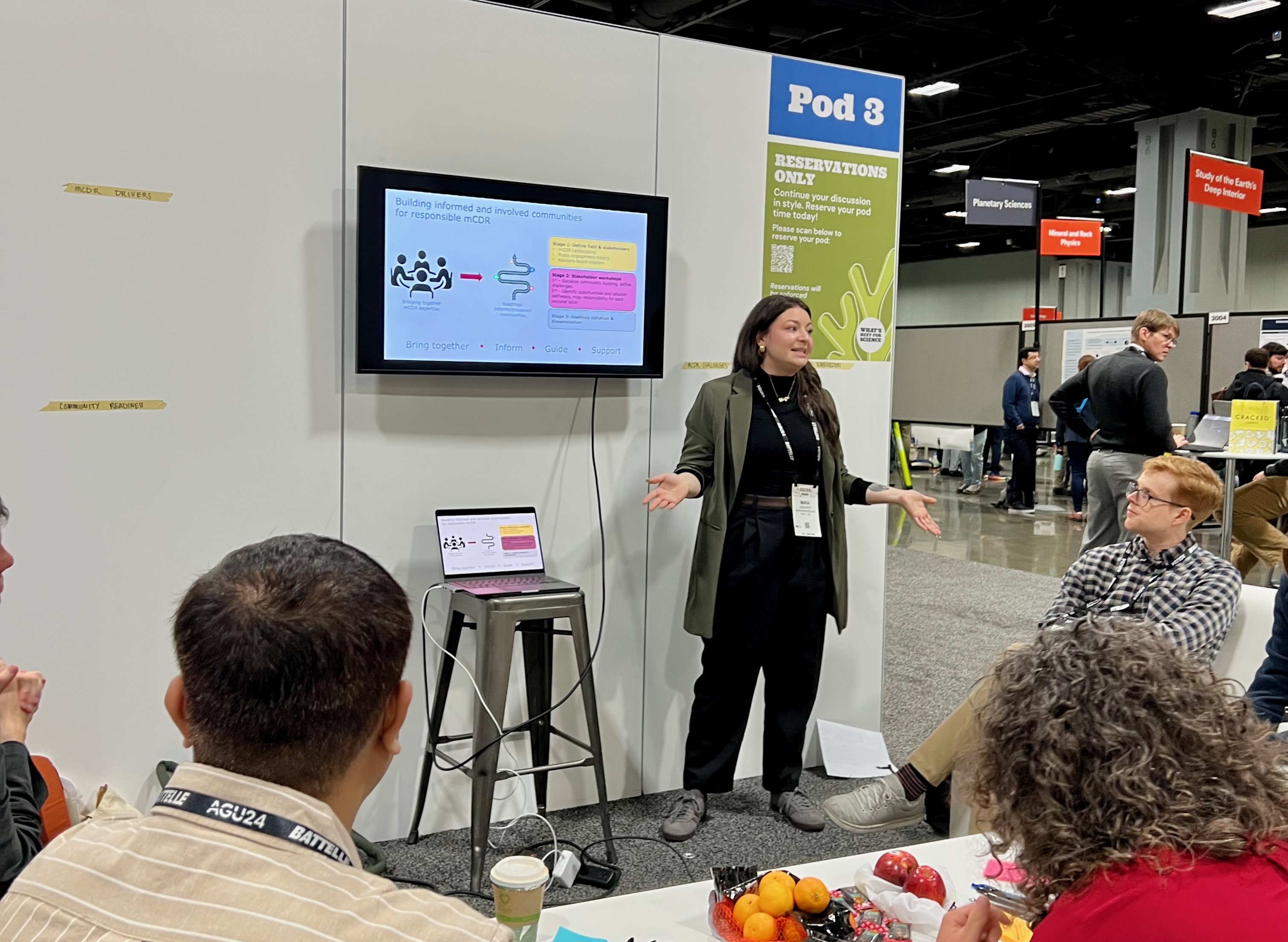
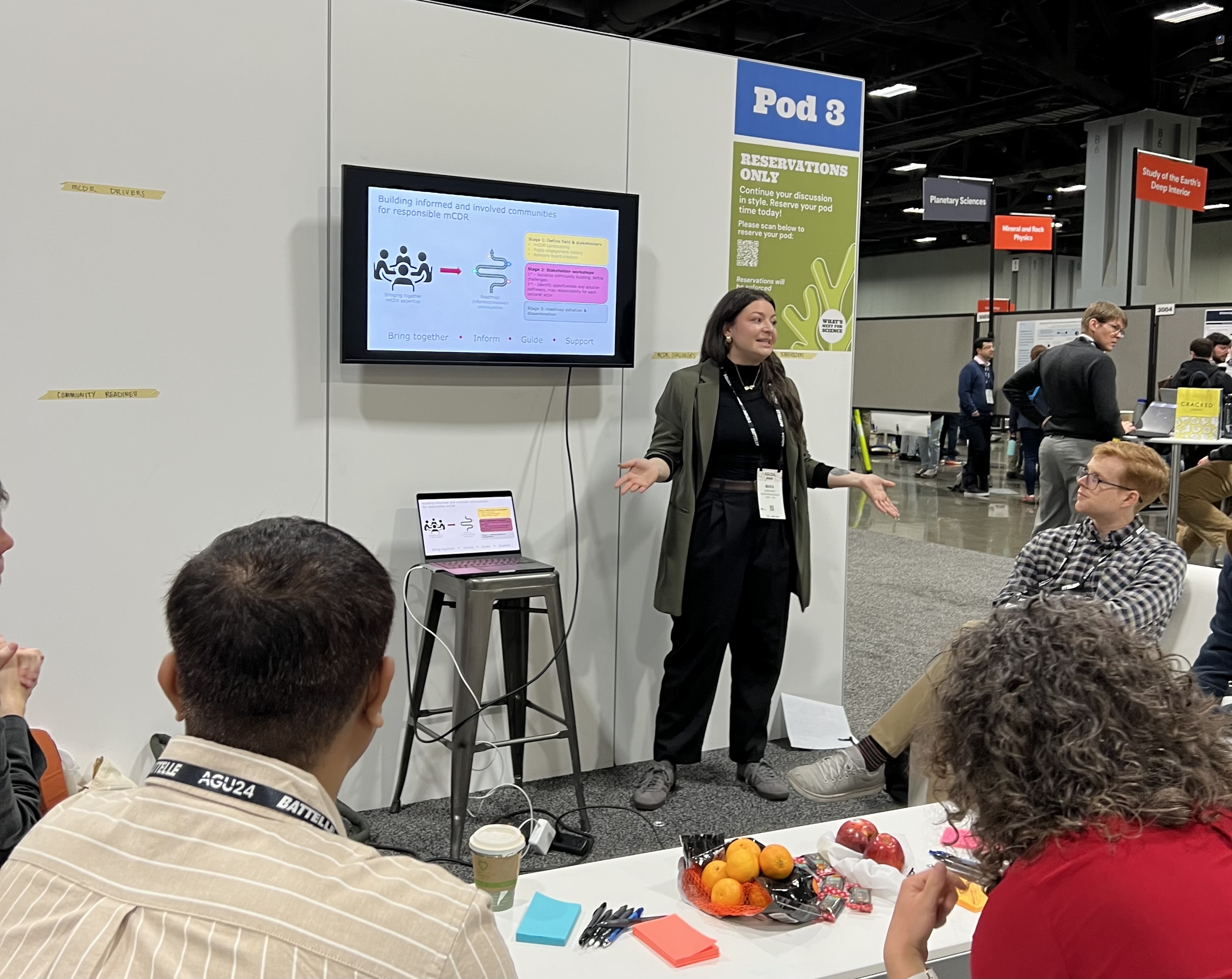
Recognizing this challenge, the Consortium for Science, Policy & Outcomes (CSPO) team members—Amanda Borth, Mara Karageozian, and Emily Hostetler—hosted community listening sessions at AGU about the future of CDR public engagement. CSPO organized three sessions linked to NSF-funded initiatives, including a Workshop Series for Marine Carbon Dioxide Removal and planning for a Research Center focused on Participatory Governance of Climate Intervention Technologies. For the sessions, the CSPO team used AGU’s “Pod” speaking spaces – informal conversation spaces similar to a living room for science, complete with cozy couches. The comforting and inviting spaces were ideal for bringing folks together and opening dialogue among a broad group of participants. Notably, the ‘Pods’ created a space where conference goers could still engage in stimulating, innovative thinking and reconnect with colleagues in an informal space to complement the more formal presentation and poster sessions.
In this informal space, we used these sessions to connect (and sometimes reconnect!) experts from the National Oceanic and Atmospheric Administration (NOAA), National Renewable Energy Laboratory (NREL), Pacific Northwest National Laboratory(PNNL), Arizona State University, Duke University, and other organizations, showing the widespread commitment to CDR public engagement. The listening sessions created the ideal space for old colleagues to reconnect and form new connections while sharing perspectives that reflected on personal experiences working in CDR and societal gaps/needs for social science research on CDR. Key topics that came up in conversation included the importance of building a safe space for CDR discourse and building trust with local communities. The discussions also highlighted that diverse perspectives and ongoing public involvement aren’t just beneficial—they’re essential for the future of climate intervention technologies. The CSPO team plans to incorporate the feedback and sentiments shared in the listening sessions into the mCDR Workshop Series and Research Center projects. Including these broad community viewpoints in project planning allows us to shape the projects best to fit the needs of our broader CDR community and support our public engagement efforts.


Following the Tide Forward
As we move forward, these collaborative efforts at conferences like AGU are vital in connecting scientific progress with society’s needs, ensuring our climate response is both technically sound and socially responsible. What’s next for the CSPO CDR team? Find us at the Ocean Visions Biennial Summit in late March!
 Expert & Citizen Assessment of Science & Technology