Skip to content

Expert & Citizen Assessment of Science & Technology

A Distributed Network of Institutions for Peer to Peer Public Deliberation

Search
  • About
    • History
  • Events
  • Partners
  • Projects
    • WWViews on BiodiversityWorld Wide Views on Biodiversity 2012
    • NASA Asteroid InitiativeParticipatory Technology Assessment of NASA’s Asteroid Initiative
    • WWViews Climate and Energy
    • WWViews on Oceans and Seas
  • Publications
    • Genetically Engineered Algae Public Engagement Strategies
    • Informing NASA’s Asteroid Initiative: A Citizen’s Forum
    • Technology Assessment and Public Participation: From TA to pTA
    • Reinventing Technology Assessment for the 21st Century

Understanding and addressing the social dimensions of carbon removal

26Oct 202426 Oct 2024

Right now, environmental and climate scientists across the world are racing to develop a plan to reverse the Earth’s warming climate.

Carbon removal — a process to slow (and even possibly reverse) climate change by capturing and storing carbon — is one of the techniques that experts consider “critical” to reaching the American goal of having net-zero greenhouse gas emissions by 2050.

While many people across the globe suffer at the hand of global warming, addressing the issue isn’t simple. The process of carbon dioxide removal (CDR) from the atmosphere isn’t just complex to implement: It will also deeply affect the lived experiences of families and communities where the industry exists. And it may be the social dimensions of carbon removal that are tougher to manage.

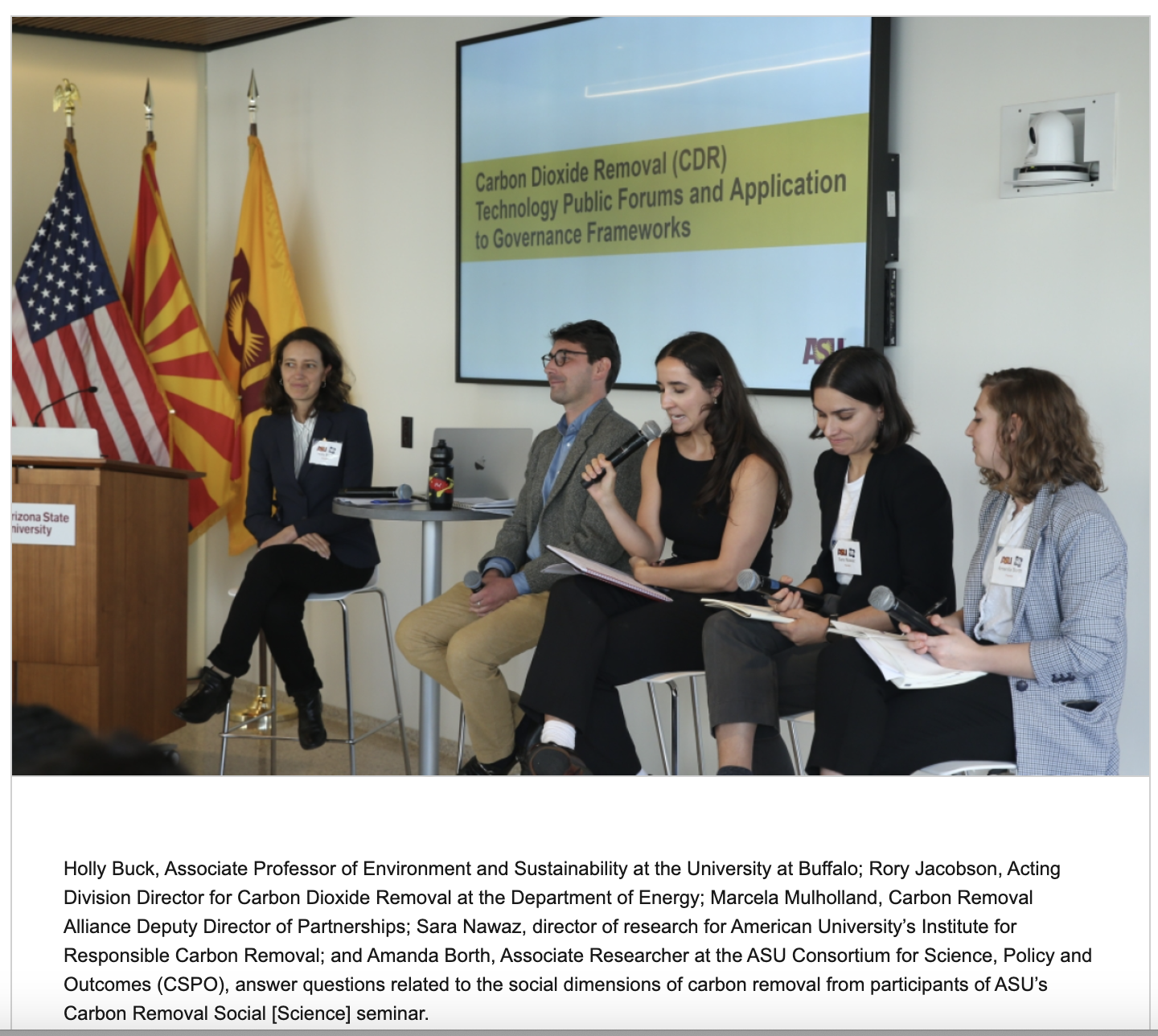
“I think for all of my time working in CDR, I felt like the social risks of deployment, the community dynamics, and host sites where we’re trying to employ these technologies has been an undervalued and underappreciated part of what’s going to what it’s going to take to scale this industry,” said Marcela Mulholland, deputy director of partnerships for the Carbon Removal Alliance, at an Arizona State University seminar discussing the social dimensions of CDR. “It feels like the world of social science research for CDR should be at least comparable to the kind of technical research that we see for these technologies. Too often, they’re siloed, and the people in the technical world don’t necessarily talk to or incorporate the findings from the social scientists into their work.”

The seminar — held on October 3 at the ASU Barrett & O’Connor Center in Washington, D.C. — was twofold, with researchers discussing what they’ve learned while studying the social dimensions of CDR while also questioning how future carbon removal processes can be more responsible to the communities it inhabits. Held blocks from the White House by the Consortium for Science, Policy & Outcomes at ASU, the group of experts and attendees were prompted to consider how considering the social dimensions of CDR could make a difference in its success.

Read Full Story at ASU News

Share this:

  • Click to email a link to a friend (Opens in new window) Email
  • Click to share on X (Opens in new window) X
  • Click to share on Facebook (Opens in new window) Facebook
  • Click to share on LinkedIn (Opens in new window) LinkedIn
  • More
  • Click to share on Reddit (Opens in new window) Reddit
  • Click to share on Pinterest (Opens in new window) Pinterest
  • Click to share on Tumblr (Opens in new window) Tumblr
Like Loading...

Related

Categories:
  • ASU CSPO
  • In the news
  • Public Engagement
Unknown's avatar

Published by Mahmud Farooque

View all posts by Mahmud Farooque

Tags: climate, climate-change, environment, global-warming, Public Engagement, Public Participation, Science and Technology Policy, sustainability

Post navigation

Previous Reinventing Participatory Technology Assessment (pTA)
Next Open Framing Case Studies in Inclusive and Equitable Public Participation Design

Dan Sarewitz on importance of citizen deliberation on science and technology

Recent Posts

  • CSPO at AGU24 – Connecting the Science and Society of CDR with Pods and Presentations
  • Open Framing Case Studies in Inclusive and Equitable Public Participation Design
  • Understanding and addressing the social dimensions of carbon removal
  • Reinventing Participatory Technology Assessment (pTA)
  • What Can UK Stem Cell Dialogues Tell us About Engaging the Public on Human Genome Editing?

Categories

Contact Us

Email us at cspodc@asu.edu
Call us at 202.446.0397

Blog at WordPress.com.
  • Reblog
  • Subscribe Subscribed
    • Expert & Citizen Assessment of Science & Technology
    • Join 25 other subscribers
    • Already have a WordPress.com account? Log in now.
    • Expert & Citizen Assessment of Science & Technology
    • Subscribe Subscribed
    • Sign up
    • Log in
    • Copy shortlink
    • Report this content
    • View post in Reader
    • Manage subscriptions
    • Collapse this bar
%d